
Harsh Rathore
A Buyer’s Guide to Choosing the Right Automatic School Bell & Announcement System
Thursday, February 5 2026

For decades, school discipline and time management depended heavily on manual processes — bells rung by staff, verbal announcements over microphones, and schedules maintained by individuals. While this worked in smaller institutions, modern schools have grown far beyond those limitations.
Today’s campuses are larger, more dynamic, multilingual, and technology enabled. As a result, time management and announcements are no longer operational tasks — they are institutional systems.
This guide explains what to look for when choosing an automatic school bell and announcement system, especially for schools planning long-term, reliable adoption.
What Is an Automatic School Bell & Announcement System?
An automatic school bell system is designed to ring bells and play announcements at pre-defined times without manual intervention.
At a basic level, such a system:
- Triggers period bells, breaks, assemblies, and dispersals
- Follows a programmed daily and weekly schedule
- Eliminates dependence on individuals to operate bells manually
More advanced systems go beyond bells and also handle announcements, alerts, and institution-wide communication in a structured and consistent manner.
Why Manual and Basic Bell Timers Are No Longer Sufficient
Many schools still rely on:
- Manual bell switches
- Basic keypad-based timers
- Systems that require physical presence near the panel
These approaches create common issues:
- Missed or delayed bells due to human dependency
- Inconsistent announcements
- Difficulty handling exams, half-days, or sudden changes
- Operational confusion during emergencies
As institutions scale, these limitations become more visible and disruptive.
Ease of Operation for Non-Technical Users
One of the most overlooked factors while selecting a bell system is who will operate it daily.
Modern schools need systems that:
- Do not require technical training
- Are intuitive for administrative staff
- Can be managed without opening electrical panels
Mobile Application vs Browser-Based Interfaces
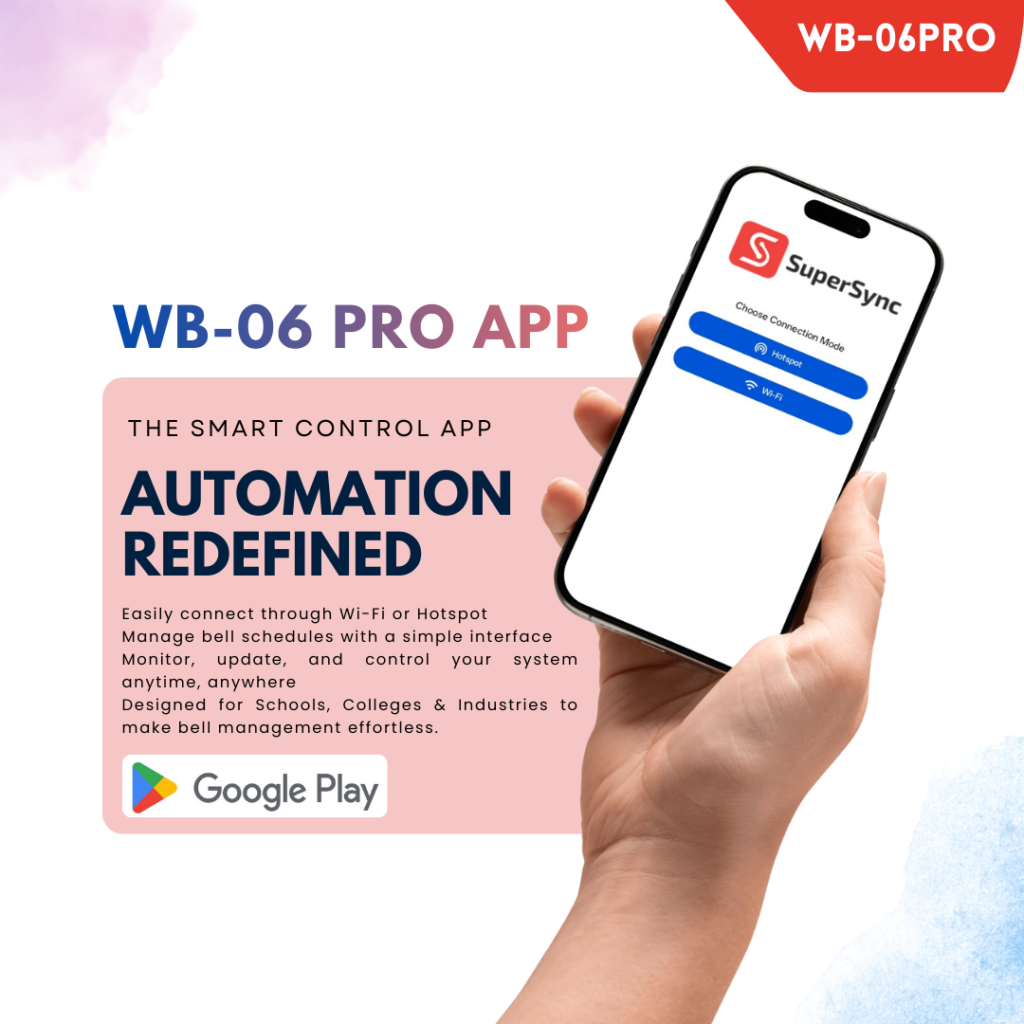
Many systems rely on hotspot-based browser pages for configuration. While functional, these interfaces often feel technical and unfamiliar.
A dedicated mobile application, on the other hand:
- Feels familiar to most users
- Reduces hesitation and errors
- Makes schedule changes faster and more intuitive
Ease of use directly affects how reliably a system is used over the years.
Connectivity & Operational Flexibility
Connectivity defines how flexible and scalable a bell system will be.
A well-designed system should support multiple modes of operation, such as:
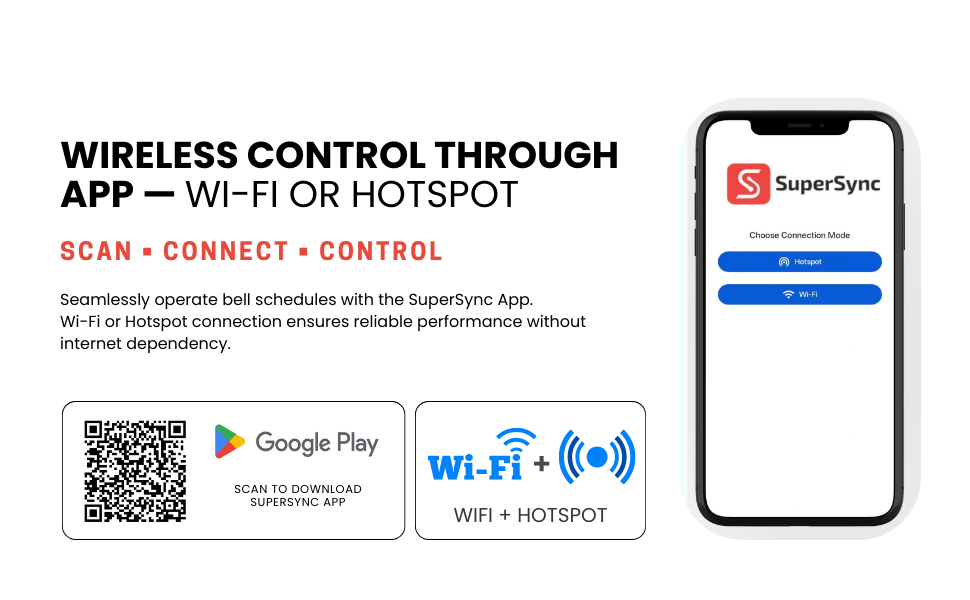
- Local device hotspot (for standalone operation)
- Integration with the school’s existing Wi-Fi network
- Bluetooth for quick, direct audio playback
Each connectivity layer serves a different purpose:
- Hotspot enables initial setup and standalone use
- Wi-Fi integration allows campus-wide access without physical proximity
- Bluetooth enables instant playback of recorded messages without extra equipment
Systems limited to a single connectivity method often restrict real-world usability.
Announcement Methods: Beyond the Microphone
Traditionally, announcements depend on:
- A microphone
- The confidence and clarity of the person speaking
- Correct pronunciation and tone
This approach has inherent limitations.
Text-Based Live Announcements
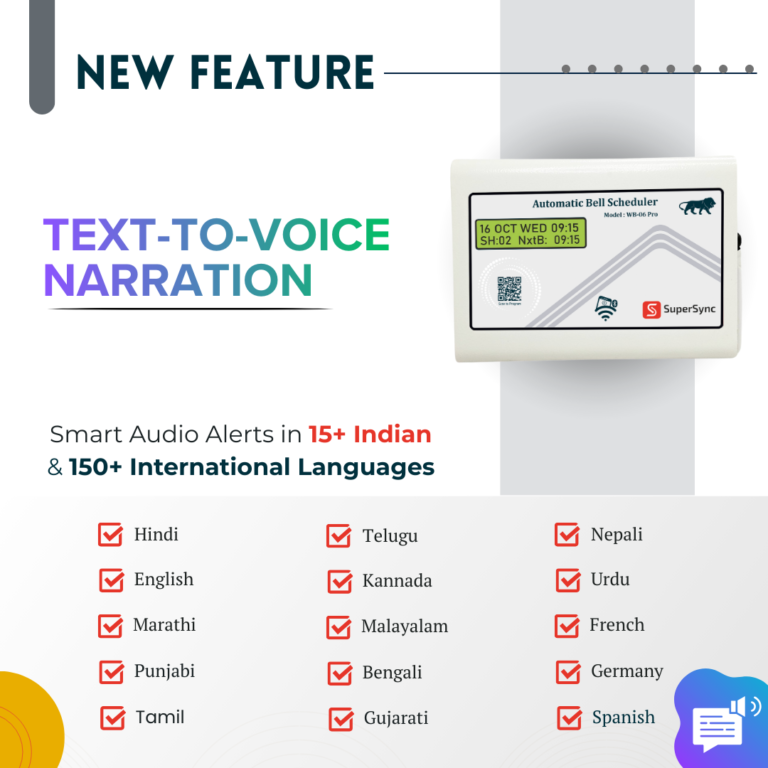
Modern systems now allow live announcements by typing text, which is instantly narrated in a professional, consistent voice.
This method:
- Eliminates the need for microphones
- Removes human hesitation or accent issues
- Ensures the same tone and clarity every time
The system speaks — not the individual.
This is especially valuable during urgent announcements where clarity and calm delivery matter more than speed.
Multilingual Communication Requirements
Indian and international schools often operate in multiple languages.
A robust system should support:
- Text-to-voice narration for live announcements in multiple languages
- Pre-recorded multilingual announcements, played instantly when required
Multilingual capability should not be an afterthought. It is essential for:
- Regional language inclusivity
- International campuses
- Standardised communication across diverse student populations
Practical Scheduling vs Unnecessary Complexity
Some bell systems advertise thousands of programmable events as a selling point. In practice, this often increases:
- Setup complexity
- Chances of configuration errors
- Long-term maintenance difficulty
A better approach is:
- Providing enough scheduling flexibility for real school operations
- Keeping programming logical and easy to manage
- Avoiding unnecessary layers that complicate daily use
Effective systems prioritise clarity over exaggerated numbers.
Reliability for Daily, Unattended Operation
School bell systems are expected to run:
- Every day
- Without supervision
- Without frequent adjustments
Reliability is not about features — it is about:
- Stable long-term operation
- Predictable behaviour
- Confidence that the system will perform consistently
This is particularly important because even a single failure can disrupt the entire campus routine.
Scalability as Institutions Grow
Schools evolve over time:
- More classrooms
- More speakers
- More schedules
- More announcements
A good system should scale without redesigning the entire setup.
Scalability means:
- The same system remains usable as requirements grow
- No forced replacement due to expansion
Long-term return on investment
Compatibility with Existing Infrastructure
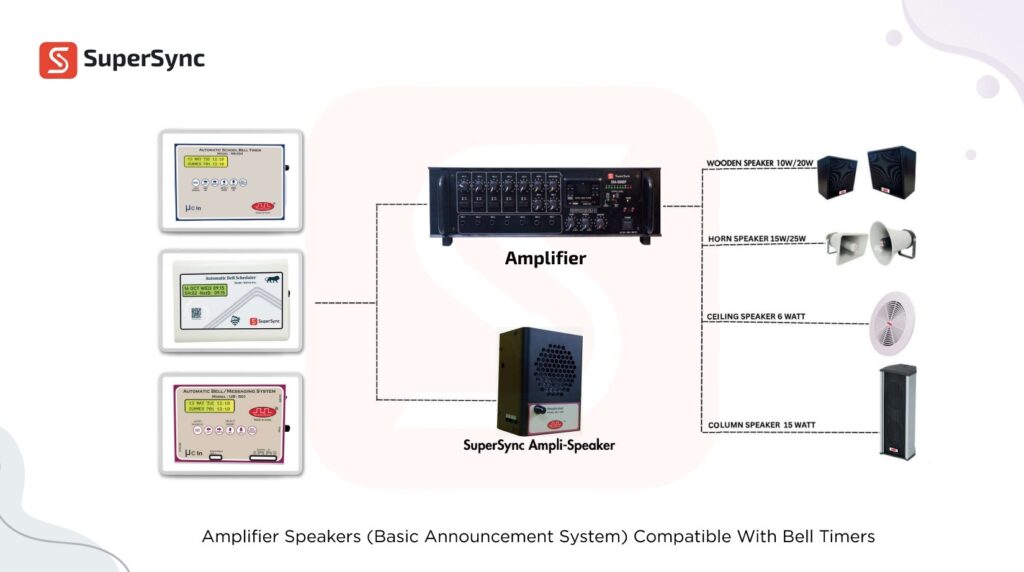
Replacing amplifiers, speakers, and wiring can significantly increase costs.
A well-designed bell and announcement system should:
- Integrate seamlessly with existing PA amplifiers
- Work with current speaker networks
- Avoid unnecessary infrastructure changes
Compatibility protects past investments and simplifies upgrades.
Controlled Access & Operational Responsibility
In many institutions, multiple people interact with systems. Without proper control:
- Schedules get changed accidentally
- Accountability is lost
- Confusion increases
Modern systems should support:
- Controlled access
- Clear operational responsibility
- Reduced risk of unintended changes
This is particularly important in large schools and multi-shift institutions.

Why the Manufacturer Behind the Product Matters
Beyond features, buyers should consider who designed the system.
Institutional automation is different from consumer electronics. It requires:
- Long-term design accountability
- Understanding of real school environments
- Feedback-driven product evolution
- Commitment to support over many years
Manufacturers who have worked in this domain since the early stages of school automation tend to design systems with greater emphasis on reliability, simplicity, and institutional realities.
The automatic school bell category in India did not emerge overnight — it evolved through years of practical deployments and real-world learning.
Common Mistakes Schools Make While Selecting a Bell & Announcement System
While evaluating automatic bell systems, schools often focus on surface-level specifications and overlook practical, long-term considerations. Some of the most common mistakes include:
- Choosing purely on price, without evaluating ease of use and long-term reliability
- Assuming bell systems are “fit-and-forget” devices, without considering daily operational realities
- Ignoring who will actually operate the system, leading to dependence on one trained individual
- Overvaluing exaggerated features, such as extremely high numbers of programmable events that add complexity but little real value
- Overlooking announcement quality, until complaints arise about clarity, tone, or language
- Not considering multilingual requirements, especially in schools with diverse or growing student populations
- Ignoring future scalability, assuming today’s needs will remain unchanged
Most of these issues can be avoided by selecting systems that prioritise simplicity, clarity, controlled operation, and real institutional workflows, rather than inflated specifications or short-term cost savings.
A well-chosen system should reduce daily dependency on individuals, not increase it.
Bringing It All Together: From Evaluation to Implementation
The considerations discussed in this guide reflect how modern automatic bell and announcement systems are expected to function today — as dependable institutional tools rather than basic timing devices.
Over time, the category has evolved to address real-world challenges such as:
- Ease of operation for non-technical users
- Flexible connectivity through mobile applications, Wi-Fi, and Bluetooth
- Compatibility with existing amplifiers and speaker infrastructure
- Professional, text-based live announcements without microphones
- Multilingual communication for both live and recorded messages
- Practical scheduling designed around real school workflows
Today, systems built around these principles make it possible for institutions to manage time discipline and announcements with far greater consistency and professionalism.
One such implementation is WB-06 Pro, an automatic school bell and announcement system designed to align with the exact requirements outlined in this guide. It brings together app-based control, campus network connectivity, Bluetooth-enabled announcements, live text-to-voice narration, multilingual support, and institution-focused scheduling in a single platform.
At SuperSync Technologies, our involvement in automatic school bell systems dates back to 2007, a time when bell automation was still in its early stages in India. Many of the principles discussed in this guide — simplicity, reliability, professional communication, and practical design — emerged from years of real institutional use and have continued to influence how such systems evolve over time
For schools, consultants, and integrators seeking a system that reflects these modern expectations, understanding how such an implementation works in real-world environments can be a logical next step.
Explore WB-06 Pro here: (https://automaticschoolbell.in/)
When chosen thoughtfully, an automatic bell and announcement system becomes an invisible support system — one that works consistently in the background, allowing institutions to focus on learning rather than managing daily schedules and announcements.