

Harsh Rathore
What IFSEC India Reveals About the Direction of Fire, Security, and Communication Systems
10 December 2025
Why IFSEC Matters Beyond an Exhibition
Events such as IFSEC India, held this year from 11–13 December at Bharat Mandapam, New Delhi, offer more than product showcases. Over time, they become indicators of how fire, security, and communication technologies are evolving in real deployments.
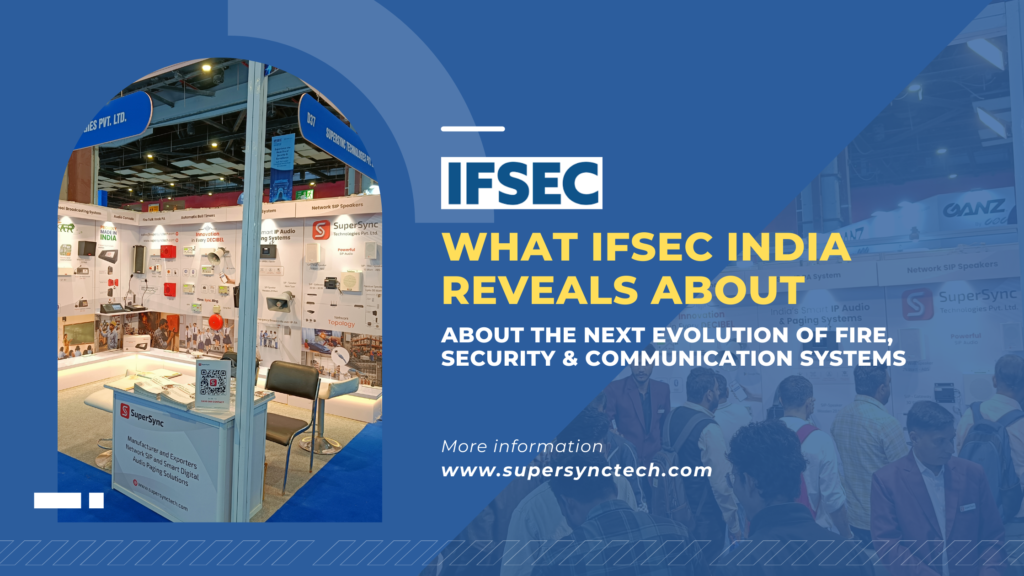
For SuperSync Technologies Pvt. Ltd., IFSEC has consistently served as a platform to engage with this evolution. The company has participated in IFSEC India every year since 2017, using the exhibition not merely to display products, but to demonstrate fully functional communication systems designed and manufactured in-house.
The observations shared in this article are therefore drawn from live demonstrations and direct interaction with consultants, system integrators, and channel partners, rather than abstract industry commentary.
A Clear Industry Shift: From Standalone Devices to Integrated Systems
One of the most consistent signals at IFSEC over the years has been the shift away from standalone devices toward integrated system architectures.
Earlier deployments typically relied on:
- Independent PA systems
- Separate bell timers and controllers
- Discrete emergency communication points
Current project discussions increasingly focus on system-level design, where paging, automation, emergency communication, and operator interfaces are planned to work together rather than operate in isolation.
This reflects practical realities:
- Buildings are now largely IT-managed
- Operators expect intuitive, unified control
- Long-term scalability and maintainability outweigh isolated feature depth
Communication Systems: Openness, IP, and Interoperability
A recurring theme across discussions at IFSEC was the growing importance of open, IP-aligned communication systems.
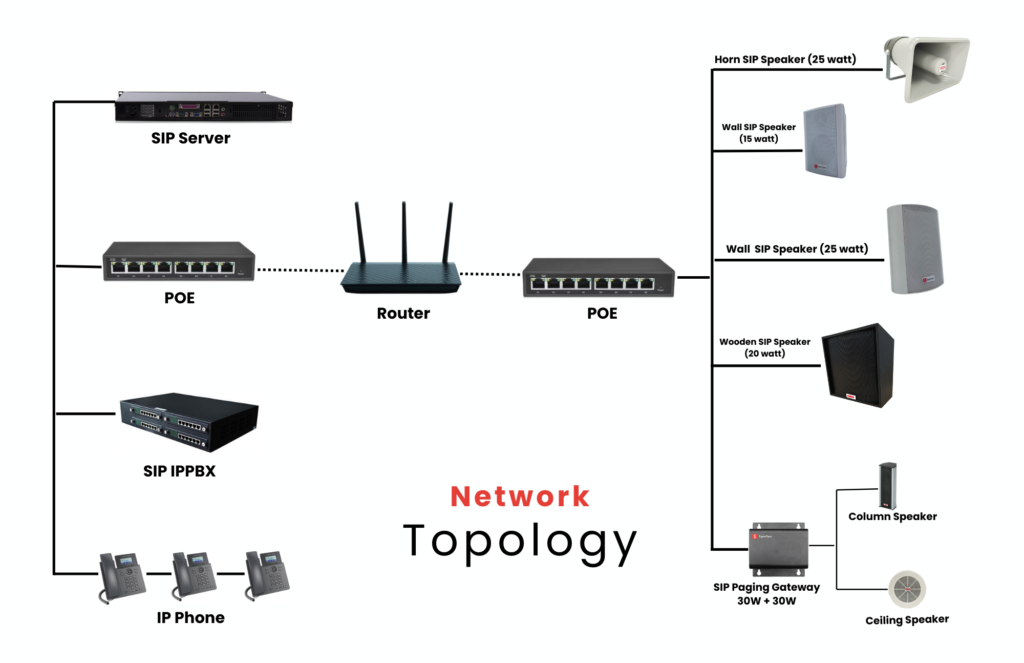
In SuperSync’s live demonstrations, this was reflected through SIP-based public address architectures operating on standard SIP IP-PBX platforms. Paging and announcements were initiated by dialing extensions from SIP IP phones, reinforcing the idea that modern PA systems are increasingly becoming extensions of enterprise communication networks, not parallel infrastructures.
Equally significant was the ability to integrate with existing analogue infrastructure using SIP-to-analogue gateways, enabling gradual migration instead of forced replacement. This mirrors a broader industry expectation: interoperability and migration flexibility are now baseline requirements.
Demonstrating Architecture, Not Just Products
At IFSEC India, SuperSync deliberately focused on demonstrating complete, working communication architectures rather than static product displays.
The systems showcased were:
- Designed and manufactured in India
- Demonstrated live under real operating conditions
- Integrated across multiple form factors and use cases
Indoor wall-mounted speakers, outdoor horn speakers, wooden cabinet speakers for large indoor spaces, SIP network speakers, and SIP-to-analogue gateways were shown operating together within a single communication framework. Full call flows—from dial-based activation on SIP IP phones to real-time audio playback—were demonstrated to emphasize system behavior and reliability, rather than individual specifications.
These demonstrations reflected SuperSync’s approach of building and manufacturing a complete public address and communication ecosystem—ranging from analogue amplification and passive loudspeakers to addressable paging systems and SIP-based network audio solutions—designed to function as a unified architecture rather than isolated components.
Usability as a System Requirement in Institutional Environments
In institutional deployments such as schools and campuses, system effectiveness is closely tied to operator experience.
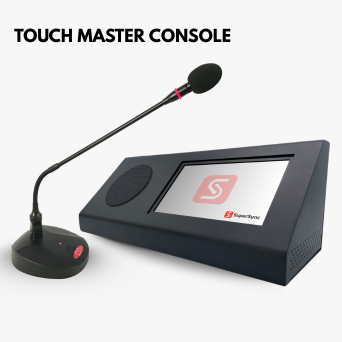
This was evident in the demonstration of school broadcasting systems built around touchscreen-based operating consoles, marking a clear evolution from earlier keypad-driven master consoles. The emphasis was not on aesthetics, but on simplifying daily operation for principals and administrators while supporting both two-way classroom communication and one-way broadcasting to common areas such as corridors, playgrounds, and assembly zones.
Another practical aspect highlighted during the demonstration of institutional communication systems was installation architecture. In school broadcasting and emergency talkback deployments, cabling topology plays a critical role in system complexity and scalability. Designs based on daisy-chain cabling patterns, rather than individual point-to-point wiring, can significantly reduce cable runs, simplify installation, and allow easier expansion across large campuses and multi-floor buildings.
Together, these factors underline a key lesson from institutional projects: as systems grow in capability, ease of operation and ease of deployment become core design requirements, not afterthoughts.
Emergency Communication: Two-Way Talkback and Preparedness
Emergency communication discussions at IFSEC increasingly extended beyond one-way alerts.
SuperSync’s demonstrations included addressable talkback systems that allow:
- Call initiation from floor-level devices
- Two-way communication with a central console
- Panic-triggered mass alert activation across multiple zones
These scenarios highlighted an important design shift: emergency communication systems are being evaluated not only on their ability to broadcast messages, but also on their capacity to receive information from the field and support coordinated response.
As with all emergency-related systems, such capabilities must always be assessed in the context of applicable standards, deployment conditions, and project-specific requirements.
Automation in Daily Operations: Reliability Over Novelty
Automation systems demonstrated at IFSEC reflected a strong focus on operational reliability.
Automatic bell and scheduling systems showcased accurate time management, synchronization stability, app-based operation, and voice announcements in multiple Indian and international languages. These capabilities address everyday operational needs where even small timing inaccuracies can accumulate into daily disruption.
The broader industry trend is clear: automation systems are expected to be precise, dependable, and easy to manage, rather than simply connected.
Addressing Real Acoustic Challenges
Beyond large-scale architectures, IFSEC also highlighted solutions designed to address specific acoustic challenges.
Counter communication systems demonstrated higher output power and extended point-to-point distance to enable clear communication across glass partitions in noisy environments such as ticket counters and service windows. These solutions reinforced a fundamental principle of communication system design: acoustic conditions often dictate system requirements as much as electronics do.
Leadership Presence and Industry Dialogue
Throughout all three days of IFSEC India, the SuperSync team—including senior leadership—was present on the stand to demonstrate systems and engage directly with industry professionals.
These interactions provided valuable insight into how communication systems are specified, deployed, and maintained across diverse projects. Continuous dialogue with integrators and consultants remains an important input into how SuperSync refines and evolves its systems year after year.
What IFSEC Signals for the Road Ahead
Taken together, observations from IFSEC India point to a clear direction for the industry:
- Communication systems are becoming architecture-driven
- Open protocols and IP alignment are increasingly central
- Usability and deployment practicality matter as much as performance
- Emergency communication is evolving toward interaction, not just broadcast
SuperSync’s continued participation at IFSEC since 2017—and its practice of introducing new system developments each year—reflects a long-term commitment to building practical, Made-in-India communication systems aligned with real-world requirements.
As fire, security, and communication technologies continue to converge, the future will favor manufacturers who focus not just on devices, but on thoughtfully designed, interoperable systems.