
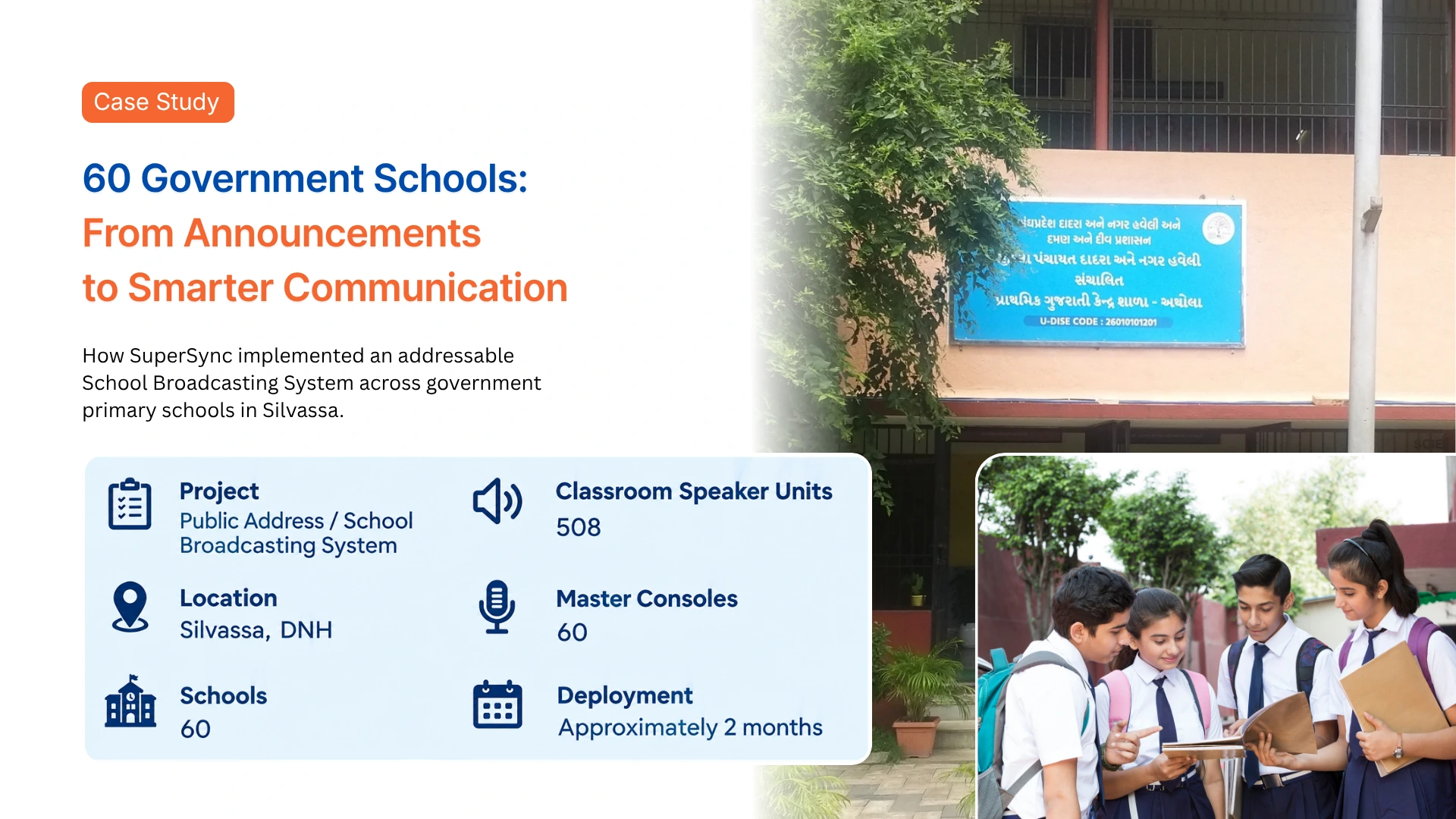
From a Public Address System to a School Communication Network
A school communication system is often thought of simply as a way to make announcements.
But in a busy school campus, communication requirements are much broader.
A principal may need to address every classroom simultaneously, communicate with one particular classroom, call a member of staff, make an announcement to a particular group, conduct the morning assembly, play scheduled audio or ensure that the school bell rings according to the timetable.
The Public Address System specified for the Silvassa government schools was designed around precisely this broader requirement.
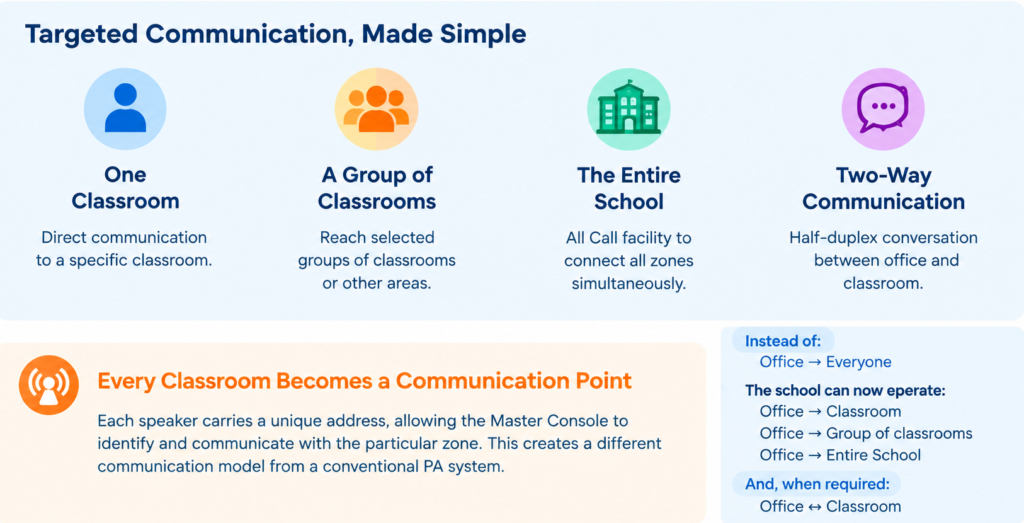
Rather than treating the school as a single audio zone, the tender specification called for an addressable communication system, allowing communication to be directed to individual zones as well as groups and the entire school.
SuperSync implemented this requirement across the participating government schools.
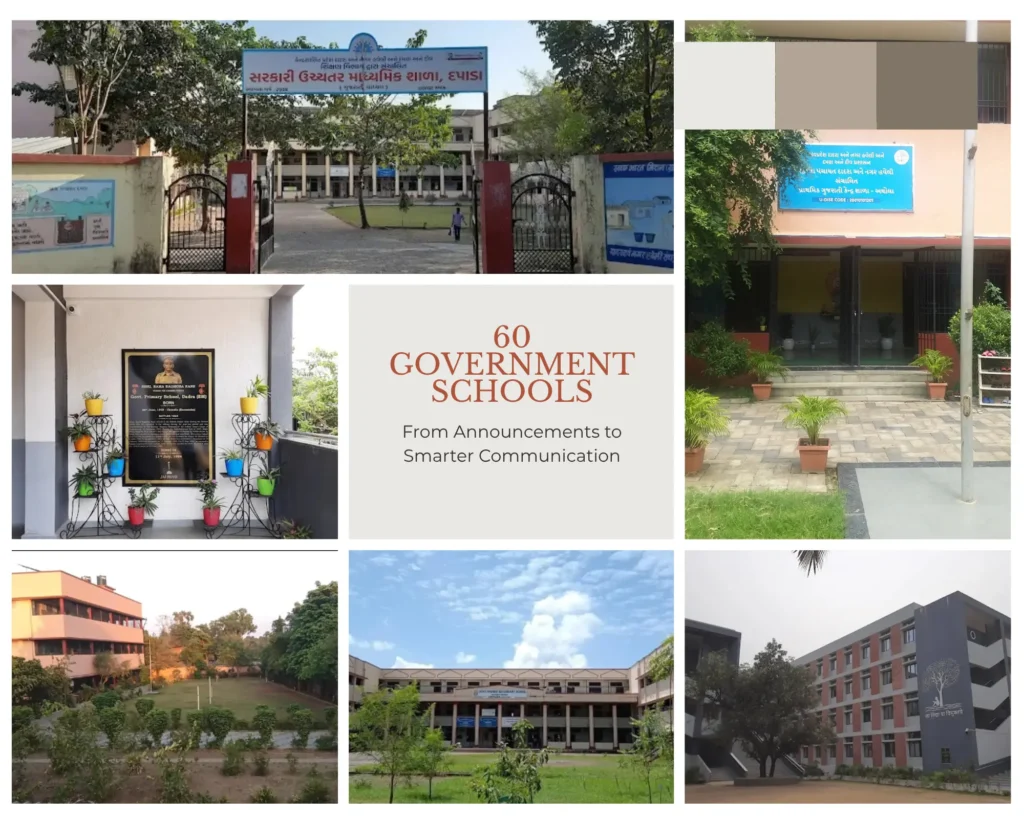
The Government Requirement
The project was awarded under a tender issued by the Office of Primary Education, District Panchayat, DNH, Silvassa.
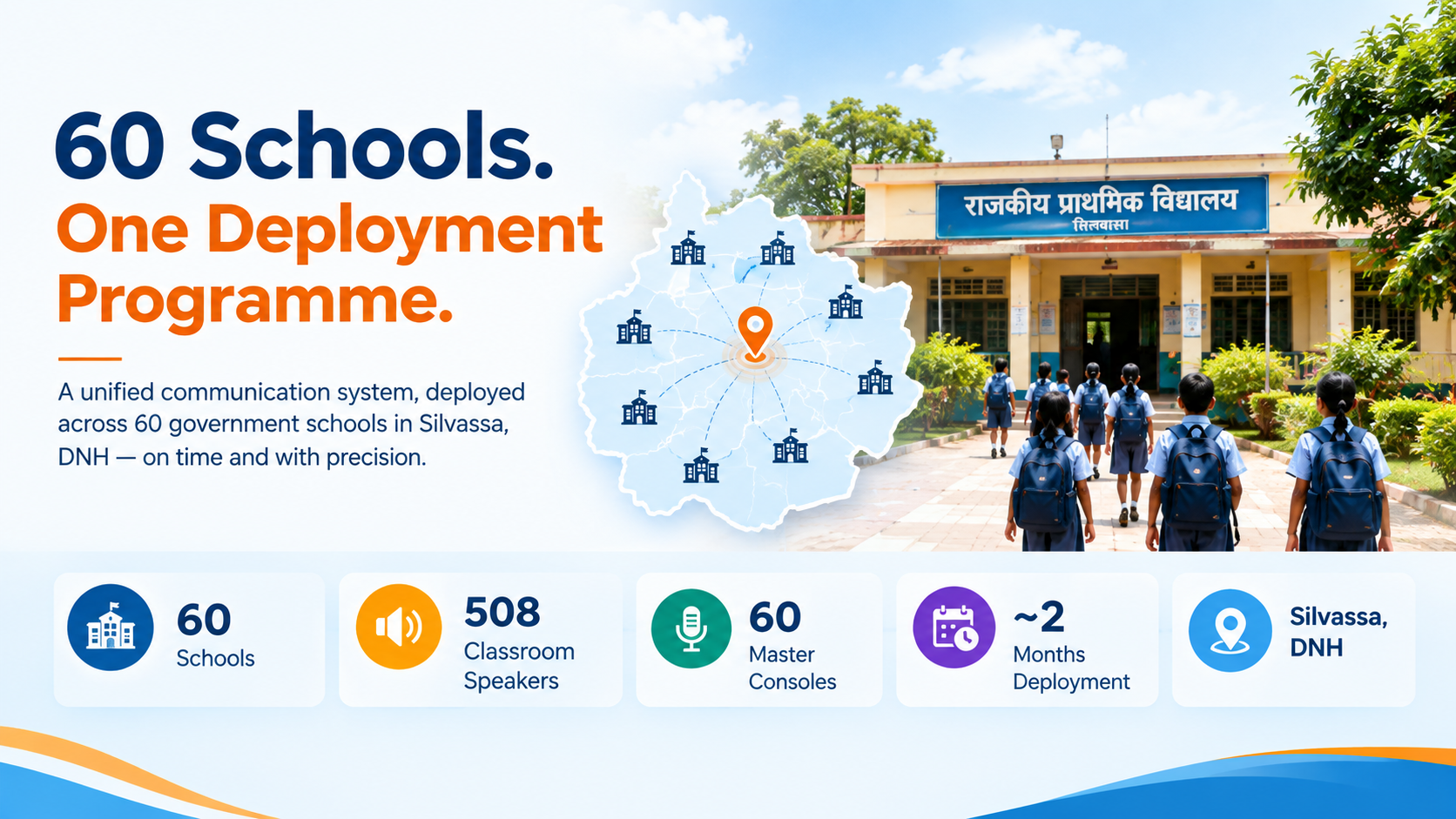
The tender called for procurement and installation of a Public Address System in 60 government schools.
- 60 Master Consoles
- 508 classroom speaker units
- 60 table-top microphones
- Dedicated system cabling
- PVC conduit for cable installation
- Addressable communication architecture
- Automatic bell/scheduled announcement functionality
The technical specification went beyond conventional PA functionality.
It specifically required one-to-one communication, talk-back, all-call, group-call, music playback and automatic messaging/bell functionality.
The SuperSync Solution
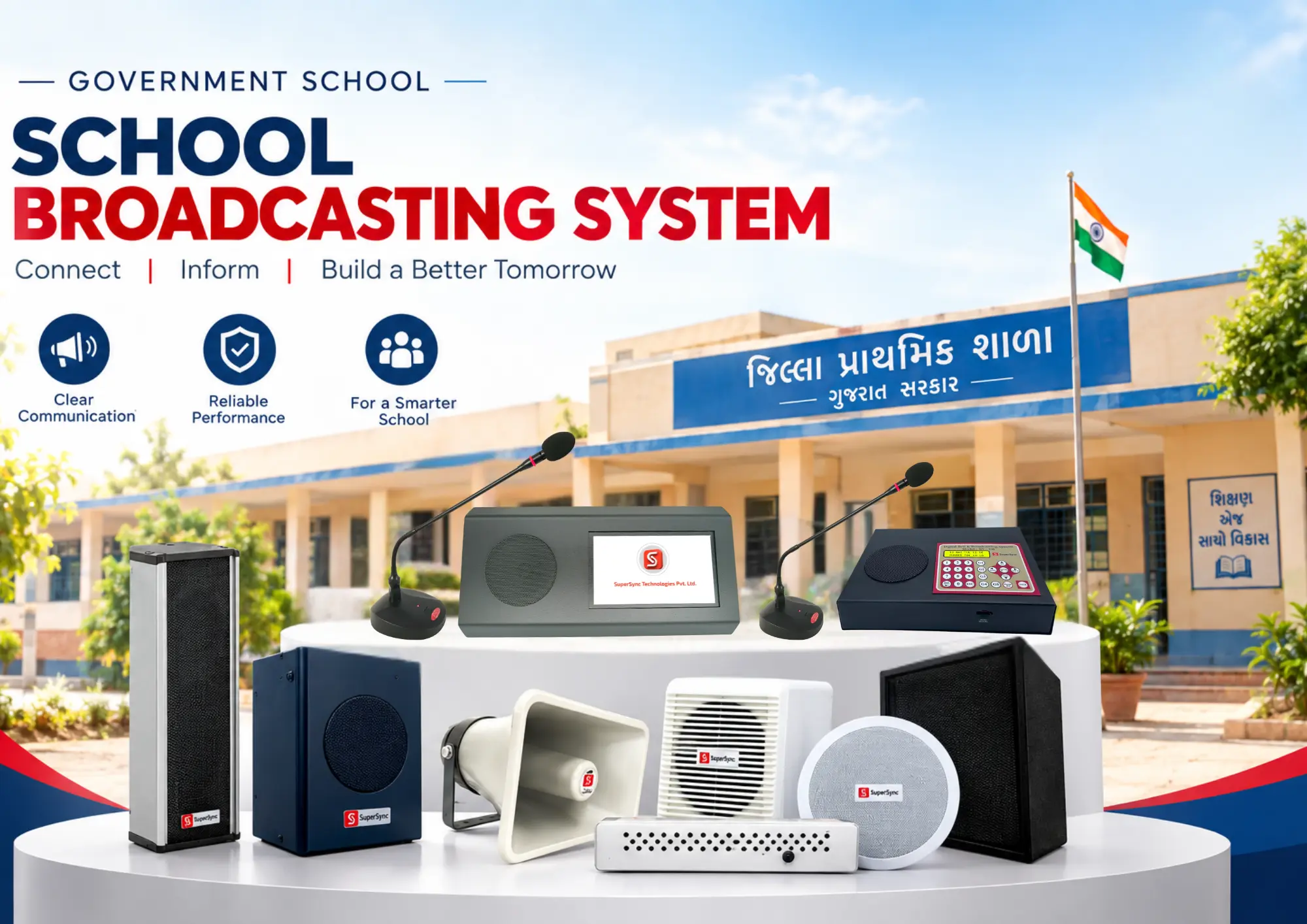
SuperSync deployed a hybrid, addressable School Broadcasting System designed around a central Master Console and individually addressable classroom speakers.
Each participating school received its own Master Console.
Each classroom received an addressable speaker with built-in microphone capability, allowing the classroom to become an identifiable communication point within the school.
This architecture allows the principal or operator to control where the communication goes, rather than simply broadcasting everything everywhere.
Automating the School Bell
The project also incorporated automatic bell and scheduled announcement functionality.
The tender specification requires automatic scheduling, including the ability to program the day’s bell schedule and scheduled messages.
For the schools, this meant that the school bell no longer had to depend entirely on manual operation.
The system could follow the programmed timetable and deliver the scheduled bell across the connected classrooms.
The same infrastructure could also be used for music playback through the available audio input/storage facilities.
Built for Real Government School Buildings
The project involved deploying the system across government school buildings of different sizes and layouts.
The schools typically had between approximately 5 and 20 classrooms, with most buildings being single-storey and some extending to two floors.
Dedicated cabling was installed for the broadcasting system.
The tender itself specifies a substantial cabling requirement—10,800 metres each of Cable-1 and Cable-2, along with 21,600 metres of cable laying in PVC conduit.
The system’s daisy-chain cabling architecture allowed the classroom speaker network to be extended from one unit to the next.
60 Schools. One Deployment Programme.
The installation was completed progressively over approximately two months.
SuperSync worked alongside its regional channel partner, whose trained installation team handled the deployment.
The biggest operational challenge was not the technology.
It was working around the school timetable.
Because schools could not permit installation activity to interfere with regular teaching, substantial portions of the work had to be completed during evenings and late hours.
Once installations were completed, the schools were progressively handed over their systems.
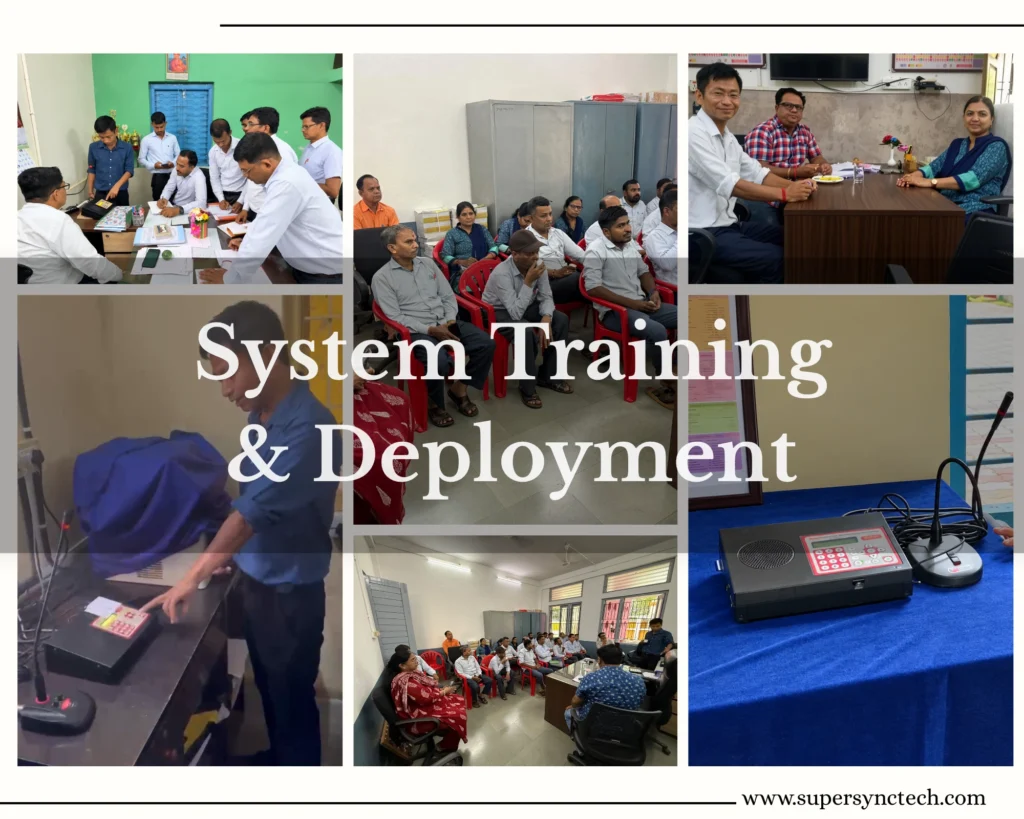
Training was conducted in batches over two days, covering representatives from all 60 schools.
Basic functions were easy for the school staff to adopt, while training helped them understand the broader capabilities of the system.
What Changed After Installation?
Better School-Wide Communication
Principals could now communicate with the entire school from their office.
Instead of depending on physical movement of staff or multiple separate announcements, a single announcement could reach the required classrooms.
This became particularly useful for assemblies, instructions, discipline, examinations and urgent announcements.
Better Staff Coordination
The ability to communicate with a particular location also changed how staff could be coordinated.
A principal could contact a staff member through the speaker at their location instead of physically searching for them.
For administrators, this turned the PA system into a staff coordination tool, not merely an announcement system.
Automatic Bell Management
The automated bell schedule removed another repetitive manual task from the school’s daily routine.
With speakers installed in individual classrooms, the scheduled bell could be delivered clearly across the school
What the Principals Experienced
The most valuable feedback came from the people actually using the system.
The principals’ feedback consistently reflected the practical difference between the previous manual approach and the new communication infrastructure.
One recurring observation was essentially:
“Earlier, we had to send someone to call a teacher. Now we can communicate directly with the classroom.”
Another was:
“We can now make an announcement to the entire school immediately.”
The feedback also highlighted the clarity of sound in classrooms, the convenience of calling specific locations and the usefulness of automatic bell operation.
And importantly, the principals did not necessarily use the system in exactly the same way.
Some focused on announcements.
Some used classroom calling.
Some valued staff coordination.
Others appreciated the automation of daily routines.
That variety became an important observation from the deployment.
The Real Measure of a Communication System
For SuperSync, the most meaningful part of the project was not simply completing a large installation.
It was seeing how the same communication infrastructure became useful in different ways across different schools.
The technology provides the capabilities.
But the real value emerges when people begin using those capabilities naturally in their everyday work.
A principal may use it to call a classroom.
A teacher may use it during an assembly.
An administrator may use it to coordinate staff.
The school may use it every day simply because the bell now happens automatically.
The system remains the same. The use case evolves with the people using it.
That is perhaps the most important lesson from the Silvassa deployment.
A successful institutional communication system is not defined only by its hardware, specifications or installation.
It is defined by whether it becomes a natural part of how the organisation communicates.
And across these government schools in Silvassa, that is exactly what SuperSync set out to build:
Not just a PA system, but a communication network for the school.