
01 October 2026
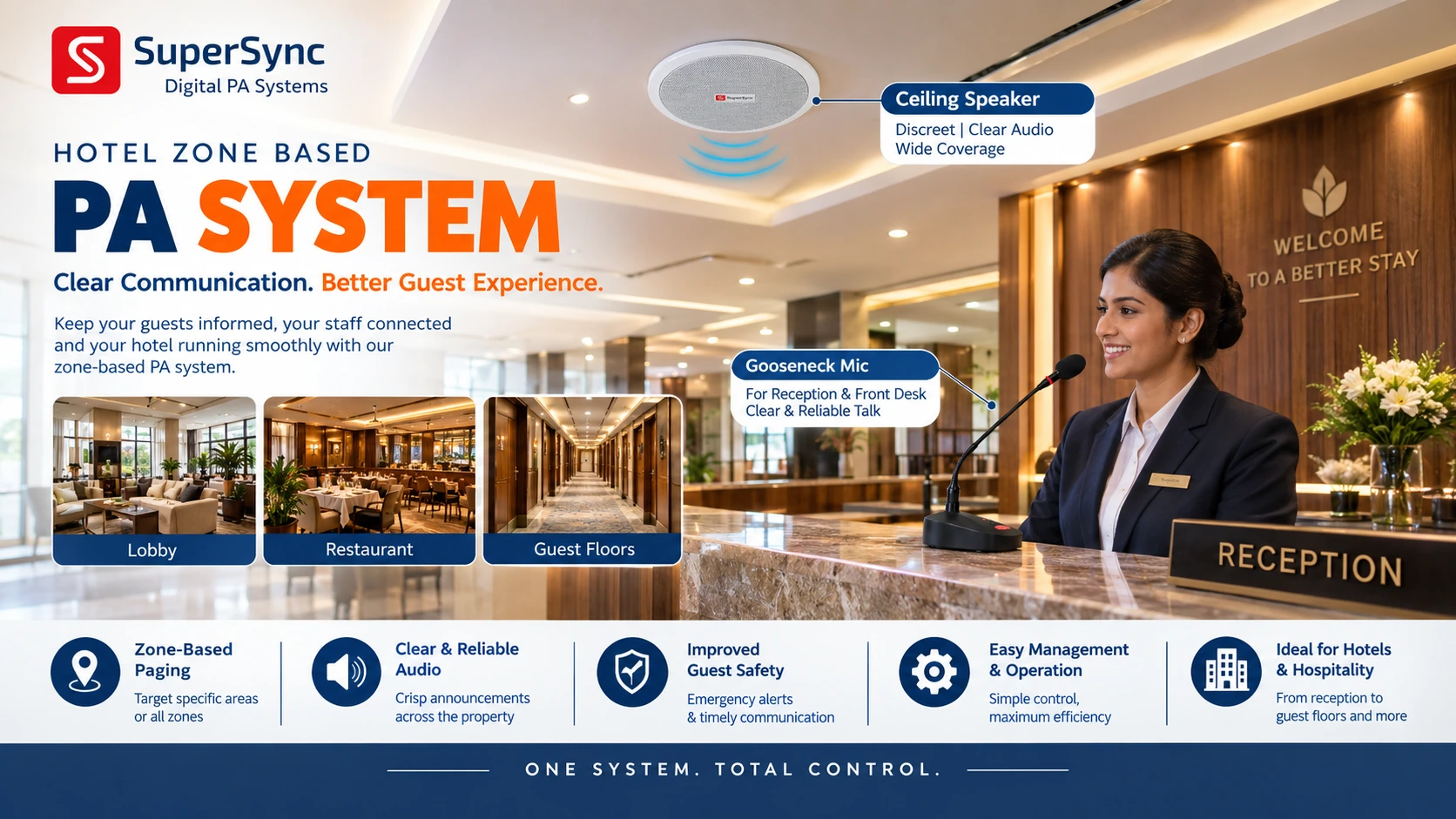
From guest experience and background music to operations and emergency communication, the real challenge is designing the right communication architecture.
A hotel is not simply a building with hundreds of rooms.
It is a collection of very different environments operating simultaneously.
There is the lobby, where guests arrive.
A restaurant where people expect a certain ambience.
Conference and banquet areas where events are taking place.
Guest floors where privacy and quiet matter.
Swimming pools and outdoor areas.
Parking and security zones.
Back-of-house areas where housekeeping, engineering, food and beverage and other teams are constantly working.
And each of these areas has a different communication requirement.
That raises a question that is often overlooked when designing a Public Address system:
Should every message really be heard everywhere?
I don’t think so.
In fact, in a hotel, unnecessary communication can itself become a problem.
A Hotel Has Another Requirement: Silence
Hotels are different from many other commercial environments because privacy, comfort and non-disturbance are part of the guest experience.
A conference announcement may be important to people attending the conference.
It doesn’t necessarily need to reach guests having dinner in the restaurant.
A housekeeping communication may be operationally important.
It doesn’t need to interrupt guests relaxing by the pool.
A security announcement may need to reach a parking area.
It doesn’t necessarily need to be broadcast across the entire property.
This is why zone-wise communication is not merely a technical feature.
It is part of good hotel operations and guest experience.
The objective is not to make more announcements.
It is to make the right announcement to the right people in the right place.
One Property. Many Communication Requirements.
A hotel may need to communicate with:
- Guests
- Reception
- Housekeeping
- Security
- Engineering
- Food and beverage teams
- Conference and event teams
- Parking personnel
- Management
- Emergency response teams
And these communications don’t all have the same priority.
A routine announcement, an operational instruction, a security message and an emergency evacuation instruction should not necessarily follow the same communication path.
This is where the concept of a communication architecture becomes more important than simply choosing speakers and amplifiers.
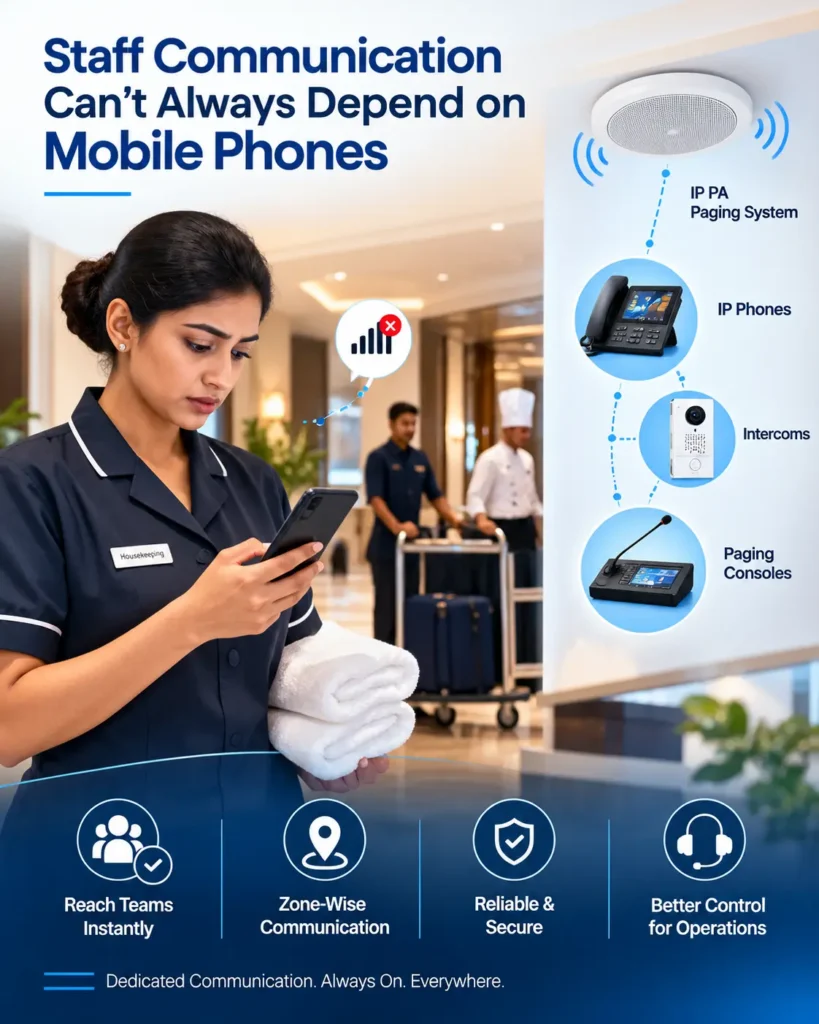
Staff Communication Can’t Always Depend on Mobile Phones
Another practical question is how hotel teams communicate internally.
For a small property, mobile phones may be sufficient for some situations.
But as the property becomes larger and more operationally complex, relying entirely on individual mobile phones isn’t always practical.
Staff may be moving between areas. Phones may not always be immediately available. Communication may need to reach a group rather than an individual. And some instructions need to originate from an authorized control point rather than from someone’s personal device.
A properly designed IP communication system can provide a dedicated communication layer for the hotel.
That could include zone-wise paging, staff communication, intercoms, IP phones or other communication endpoints depending on the requirement.
The important point is not to replace every form of communication with IP.
It is to provide the right communication mechanism where it actually adds value.
IP PA Is More Than an IP Speaker
When people hear “IP PA”, they often think only about an IP speaker connected to a network.
The architecture can be much broader than that.
Depending on the project, an IP-based communication environment may include:
- SIP servers or IP PBX systems for managing communication endpoints
- IP phones for staff and operational communication
- IP speakers in different formats for indoor and outdoor applications
- IP intercom units for point-to-point communication
- Video intercom units where visual verification is required
- Paging consoles or control stations for authorized announcements
- Networked audio endpoints for background music and communication
These don’t necessarily have to operate as isolated products.
They can become different endpoints within a common communication architecture.
A security desk could communicate with an entrance intercom.
A staff member could use an IP phone.
A control room could make an announcement to a particular zone.
An IP speaker could play background music during normal operation and become an announcement endpoint when required.
That is why I see IP PA differently.
IP is not simply a feature of the speaker. It can be an architecture for connecting different communication functions.

One Audio Infrastructure, Multiple Functions
There is another aspect that deserves attention in hotel projects: background music.
Hotels already invest significantly in audio infrastructure for background music across lobbies, restaurants, corridors, lounges, pool areas and other spaces.
So why necessarily treat music and communication as completely separate worlds?
With an appropriately designed IP audio architecture, the same networked speaker infrastructure can potentially support:
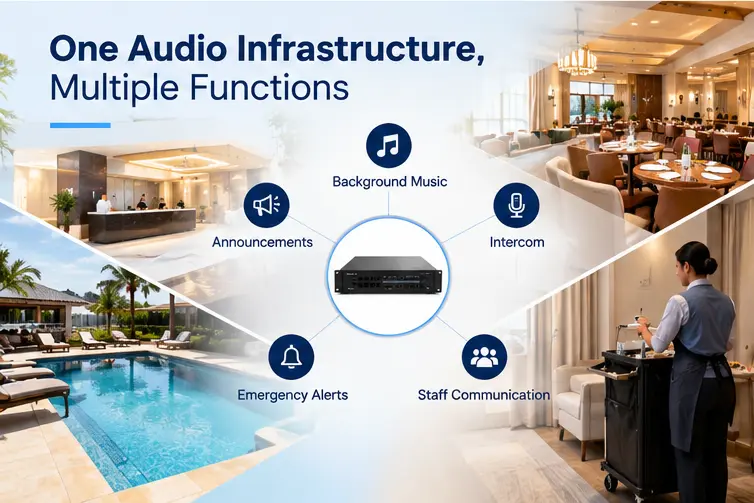
Background Music + Live Announcements + Scheduled Messages + Zone-wise Communication
The requirements will vary by project, but the underlying infrastructure can be designed to serve multiple functions.
A restaurant can have its own background music.
A conference area can have different audio content.
A lobby can have its own music and announcements.
A particular operational area can receive a staff message without disturbing the guest areas.
The value isn’t simply fewer devices.
It is the ability to make one audio infrastructure serve multiple communication requirements without treating the entire hotel as one audio zone.
Distance Changes the Infrastructure Equation
There is another reason IP PA becomes interesting as properties become larger and more distributed.
In a conventional analogue PA system, audio has to be distributed from the central equipment to the relevant speaker circuits.
As distances, zones and buildings increase, the installation requires careful consideration of cable lengths, conductor sizing, power loading and line losses.
100V line technology makes distributed analogue audio practical over long distances, but it does not eliminate these design considerations.
IP architecture approaches the problem differently.
Audio can be distributed through the network, with intelligent endpoints positioned closer to where communication is required.
Where suitable network infrastructure already exists — or can be planned efficiently — this can substantially reduce the requirement for dedicated audio cabling and make distributed systems easier to expand.
But the real advantage is not simply:
“less cable.”
It is:
the ability to distribute communication intelligence closer to where it is required.
But IP Is Not Automatically Better
This is an important distinction.
Choosing IP simply because it is newer or network-based isn’t necessarily good system design.
A smaller installation with limited zones and straightforward requirements may not need the complexity of a full IP architecture.
A large hotel with multiple buildings, many zones, centralized management, distributed communication requirements and future expansion may have a very different set of requirements.
And sometimes the answer may be hybrid.
Use IP where IP solves a problem.
Use conventional audio where conventional audio is simpler.
Connect the two where the application requires it.
The objective should always be to design the communication architecture around the property — not force the property to fit the technology.
Loud Is Not the Same as Intelligible
There is another issue that is often overlooked.
A PA system isn’t successful simply because the speaker is loud.
It is successful when people can understand the message.
Hotels contain very different acoustic environments.
A quiet corridor is different from a busy lobby.
A restaurant is different from a swimming pool.
A conference hall is different from an outdoor parking area.
Increasing volume isn’t always the answer.
Speaker selection, placement, acoustic conditions, coverage and system design all influence whether a message can actually be understood.
In communication, loudness gets attention. Intelligibility delivers the message.
And in an emergency, that distinction becomes even more important.
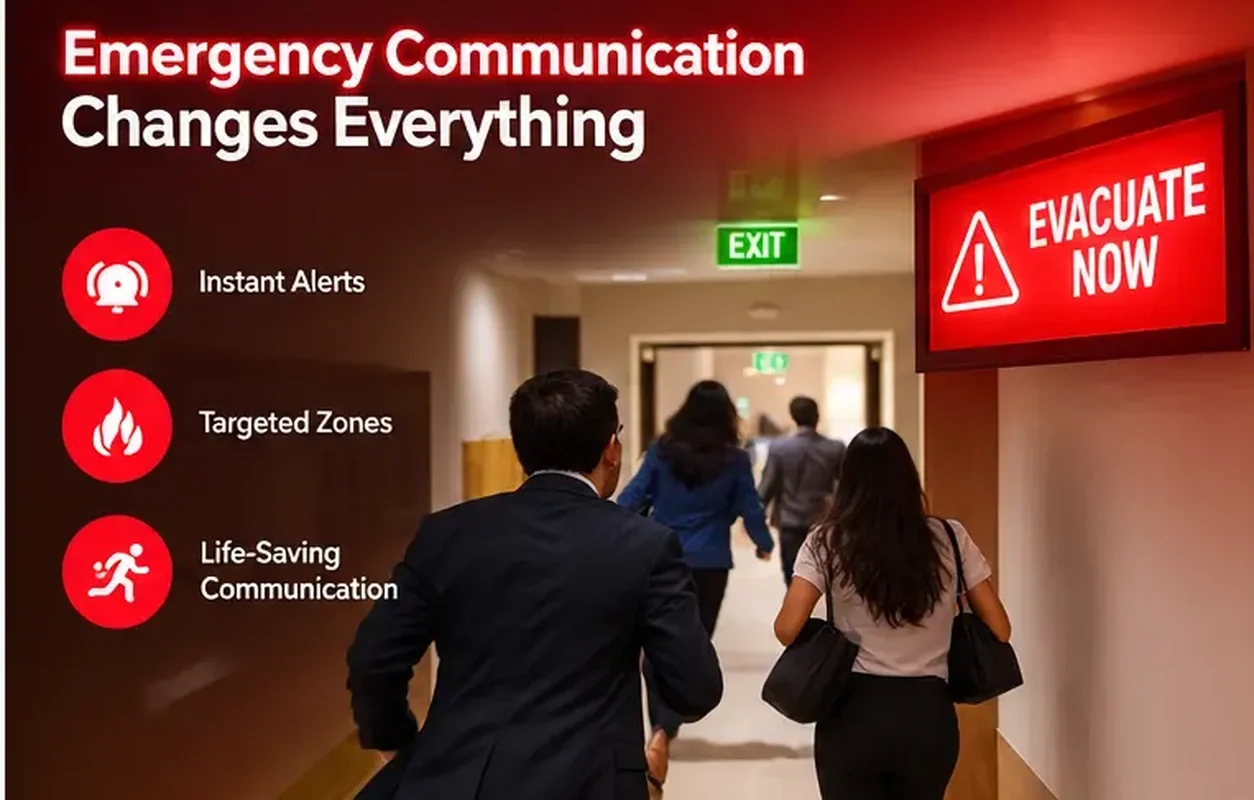
Emergency Communication Changes Everything
Under normal conditions, the objective may be:
Comfort + Information + Operations
During an emergency, the objective becomes:
Awareness + Direction + Action
A fire alarm can detect an emergency.
But detection alone doesn’t tell people what to do.
Someone has to decide:
- Which area is affected?
- Which zones need immediate communication?
- Should the entire building be evacuated?
- Should evacuation be phased?
- What instructions should occupants receive?
- Which teams need to respond?
- Should the communication expand to other areas as the situation develops?
This creates a much bigger communication chain:
Detection → Decision → Communication → Human Action
That is where a voice communication system becomes more than an audio system.
It becomes part of the building’s emergency-response architecture.
Of course, emergency and evacuation functionality must be designed according to the applicable safety requirements, standards and project-specific requirements.
And Then Comes the Question Nobody Likes to Ask
What happens when the network fails?
If communication becomes part of the hotel’s operational or safety infrastructure, network availability cannot simply be assumed.
System design may need to consider:
- Network redundancy
- Power backup
- System supervision
- Fault monitoring
- Appropriate priority handling
- Fail-safe or emergency operation
- Separation or resilience of critical infrastructure where required
This is where the conversation becomes more interesting.
Because an IP PA system isn’t simply about putting audio onto an Ethernet cable.
It is about deciding how much the hotel wants to depend on that communication infrastructure — and then engineering it accordingly.
The Real Value of IP Is Architecture
A large hotel may have hundreds of speakers.
But the number of speakers isn’t the most interesting part.
The more important question is:
How do those endpoints behave as one communication system?
Can the hotel:
- Communicate with one zone without disturbing another?
- Manage multiple buildings?
- Provide background music?
- Make scheduled announcements?
- Communicate with staff?
- Connect intercoms and IP phones?
- Prioritize important messages?
- Expand the system as the property grows?
- Integrate emergency communication appropriately?
- Monitor and manage the system centrally?
These are architectural questions.
And this is why I believe the conversation around IP PA needs to move beyond:
“How many watts is the speaker?”
and toward:
“What should the communication system be capable of doing?”
The Question Hotels Should Really Be Asking
The question shouldn’t simply be:
“Should our hotel use IP PA?”
It should be:
“What should our communication system be capable of doing when the hotel is operating normally — and when something goes wrong?”
During normal operations, it should respect the guest experience.
During busy operations, it should help teams communicate efficiently.
During events, it should deliver information to the relevant areas.
And during an emergency, it should support clear, timely and appropriate communication.
That is a much bigger responsibility than simply producing sound.
At SuperSync, this is how we increasingly look at IP-based communication systems — not merely as speakers, amplifiers or network devices, but as communication infrastructure designed around how a facility actually operates.
Because ultimately:
A hotel doesn’t need a louder communication system. It needs a smarter one.